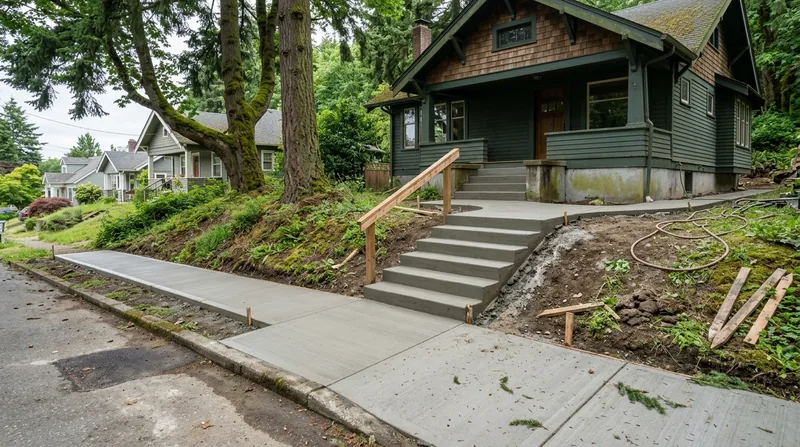




Everett's steep hillside neighborhoods, flat delta residential zones, and post-war suburban streets all depend on safe, durable sidewalks, walkways and steps to connect homes to streets, yards to garages, and porches to driveways. The Puget Sound climate, dense glacial till on the uplands, and root heave from Douglas firs and bigleaf maples create constant pressure on concrete surfaces. Settlement, frost crack, moss-covered slabs, and edge spalling are the dominant failure modes here, not just wear. A cracked or sunken walkway isn't just an eyesore, it's a liability and an access barrier. Everett Concrete Pros builds and repairs sidewalks, walkways and steps to local permit standards, ADA compliance where required, and the freeze-thaw durability this climate demands. We've worked on Victorian front walks in Rucker Hill, stepped approaches on Riverside bungalows, and modern ranch pathways across south Everett. Safe, slip-resistant access throughout your property starts with concrete that's built right.
Why Sidewalks, Walkways and Steps Matter in Everett's Wet Climate
Everett receives about 37 inches of rain annually, with long grey winters and occasional hard freezes that turn moisture into a concrete killer. Water seeps into hairline cracks, freezes, expands, and splits the slab from inside out. Shaded walkways on the north side of homes become moss and algae farms, turning safe paths into slip hazards. Hillside runoff from upland neighborhoods feeds erosion beneath sidewalks, and tree roots from mature cedars and maples heave the surface unpredictably. A well-built walkway with proper drainage, air entrainment, and slip-resistant finish isn't a luxury in Everett, it's essential infrastructure.
- Freeze-thaw cycles crack poorly finished concrete within two to three winters on Everett's exposed slopes.
- Moss and algae growth on wet, shaded surfaces creates genuine slip hazards for elderly residents and children.
- Glacial till and river-delta silt drain differently across Everett, so subsurface settlement happens unevenly beneath walkways.
- Root heave from large trees lifts and breaks concrete, especially on the steep tree-lined streets of northwest Everett and Rucker Hill.
- Curb cuts, right-of-way setbacks, and ADA compliance add local code requirements that must be met at the start, not after a repair fails.
Each of these issues compounds over time, turning a minor crack into a safety hazard and a code violation.
Key info: Everett's marine climate and dense tree canopy create the perfect conditions for moss and algae growth on walkways. A textured, air-entrained finish resists both freeze-thaw damage and slipping far better than a smooth troweled slab. We specify finishes that hold up to Puget Sound winters and stay safe year-round.
For detailed guidance on maintaining concrete in Everett's climate, see the Concrete Repair and Resurfacing page for solutions to existing damage.
How We Build Sidewalks, Walkways and Steps Built to Last in Everett
Every project starts with the site, not the concrete mix. We assess drainage patterns, tree root zones, soil bearing capacity, and local setback requirements. Everett's upland neighborhoods sit on dense hardpan that sheds water, while delta areas near the Snohomish flats hold soft silt and peat that settle unevenly. We prepare the base accordingly, install proper edge forms, and pour concrete with air entrainment and a textured finish rated for slip resistance. Final grading channels water away from the slab and any adjacent structures.
- We survey the site for drainage patterns, tree roots, and soil conditions before ordering concrete or setting forms.
- We remove old concrete and dispose of it responsibly, or leave it in place if the base is sound and we're overlaying.
- We set forms to local width, slope, and setback requirements, and verify ADA compliance for commercial or public-facing walkways.
- We pour air-entrained concrete with a textured trowel finish that resists both freeze-thaw damage and slipping on wet moss-covered surfaces.
- We finish grading and site cleanup so water drains away from the walkway and doesn't pool against foundations or create new erosion.
The result is a walkway that handles Everett's winters without cracking, resists moss growth better than smooth concrete, and meets code from day one.
Local example: A 1920s Craftsman bungalow on a Riverside hillside had a cracked front walk with root heave from an old Douglas fir. We removed the old concrete, cut back the root carefully to preserve the tree, installed a 4-inch air-entrained base with proper slope, and poured a textured finish rated for ADA compliance. The new walkway sits 2 inches below the porch sill to shed water, and has held solid through three wet winters without a single crack.
See our Concrete Leveling and Slab Lifting page if root heave or settlement is already affecting your walkway.
Methods and Materials for Everett Walkways
| Approach | Description | Best for |
|---|---|---|
| Full removal and replacement | Demo old concrete, prepare base, pour new air-entrained slab with textured finish and proper drainage. | Cracked, settled, or root-heaved walkways; new construction; homes with poor drainage or subsurface issues. |
| Concrete overlay | Clean and prime existing slab, pour new air-entrained concrete over top with textured slip-resistant finish. | Sound base with minor surface damage; homeowners wanting to avoid full demo; tight budgets on larger areas. |
| Concrete leveling and lifting | Inject polyurethane or mudjacking beneath settled slab to raise it back level, then seal and finish surface. | Sunken walkways caused by soil settlement or root heave; preserving existing concrete; avoiding full removal on steep hillside sites. |
| New stepped entry or landing | Design and pour new concrete steps with handrail footings, proper tread and rise dimensions, and non-slip finish. | Elevated porches, hillside homes, ADA-compliant access, safety upgrades on Victorian and Craftsman homes in northwest Everett. |
| Partial repair or patch | Cut out damaged section, prep edges, pour matching concrete, finish to blend with existing slab. | Localized cracks, spalling edges, small frost heave; temporary fix while planning larger replacement. |
Sidewalks, Walkways and Steps Cost in Everett: What to Expect
Sidewalk and walkway pricing in Everett starts at $6 per square foot for straightforward removal and replacement on level or gently sloping ground with good drainage and no tree roots. A 4-foot-wide, 20-foot-long walkway at that rate runs about $480 before permits and site prep. However, Everett's actual terrain and climate push most jobs higher. Hillside sites with steep grades, poor drainage, or mature tree roots nearby add complexity and cost. Freeze-thaw durability requires air-entrained concrete and a proper textured finish, not just a basic slab. Settlement issues on delta properties or root heave on upland streets may require base preparation or leveling work before concrete is poured.
Several factors move the final price above the baseline. Tree root zones demand careful excavation and sometimes root cutting, which adds labor. Sloped or stepped designs cost more than flat walkways. ADA compliance, curb cuts, or right-of-way permits add permitting time and design verification. Soil conditions on the delta (soft silt and peat) or uplands (dense hardpan) affect base prep. The best approach is to get 2 to 3 estimates from insured contractors. Each estimate should specify the concrete mix, finish type, drainage plan, and any base prep required. Comparing three quotes tells you whether a site has hidden challenges and what the market rate is for your specific location and conditions.
For a detailed breakdown of pricing across all our concrete services, visit the full pricing page.
Sidewalks, Walkways and Steps Near Me: What to Look for When Hiring a Concrete Contractor in Everett
Finding a trustworthy concrete contractor near Everett starts with three non-negotiables: current general liability insurance, active workers compensation coverage, and verifiable references. Insurance protects you if someone is injured on the job or property damage occurs. A contractor without workers comp is exposing you to liability and potential legal claims. Ask for a certificate of insurance before work begins, and verify it's current. Check references from recent jobs in your neighborhood, especially other hillside or delta properties where drainage and soil conditions match yours. Ask specifically about how the contractor handled tree roots, drainage, or settlement issues.
- Confirm the contractor carries general liability and workers compensation insurance with a certificate issued within the last 30 days.
- Ask for at least three local references and call them to ask about drainage, durability, and whether the walkway has cracked or settled since completion.
- Get written estimates from 2 to 3 contractors specifying concrete mix, air entrainment, finish type, base prep, and drainage plan.
- Verify that the contractor understands Everett's local permit requirements for sidewalk width, setbacks, curb cuts, and ADA compliance if needed.
- Ask whether the contractor has experience with root heave, glacial till, or delta silt, and how they address those site-specific challenges.
A contractor who can explain why Everett's freeze-thaw cycles demand air-entrained concrete, and why moss-covered slabs need textured finishes, is one who understands the local climate and won't cut corners.
Ready to discuss your project? Contact Everett Concrete Pros for a free, no-obligation estimate. Call (425) 551-7377 or fill out our online form, and we'll respond within 24 hours with a site visit and detailed quote.
Sidewalks, Walkways & Steps in Everett: Pricing Guide
| Service | Price | Details |
|---|---|---|
| Standard sidewalk or walkway | Starting at $6/sq ft | Removal, base prep, air-entrained concrete, textured finish, drainage; level to gently sloped sites without tree roots |
| Hillside or root-affected walkway | Starting at $8-$12/sq ft | Extra base preparation, careful root cutting, slope grading, enhanced drainage; sites in northwest Everett, Rucker Hill, or steep neighborhoods |
| Concrete steps or stepped entry | Starting at $1,200-$2,500 | Design, handrail footings, proper tread and rise dimensions, textured slip-resistant finish; ADA-compliant Victorian or Craftsman homes |
| Concrete leveling or slab lifting | Starting at $800-$2,000 | Polyurethane injection or mudjacking beneath settled slabs; cost depends on slab size, settlement depth, and accessibility |
| Estimate and consultation | Free | Site visit, drainage assessment, soil evaluation, permit review, written quote; response within 24 hours, no obligation to book |
Indicative pricing, the exact cost depends on square footage, finish, and site access. Free personalized estimate within 24h at (425) 551-7377.


